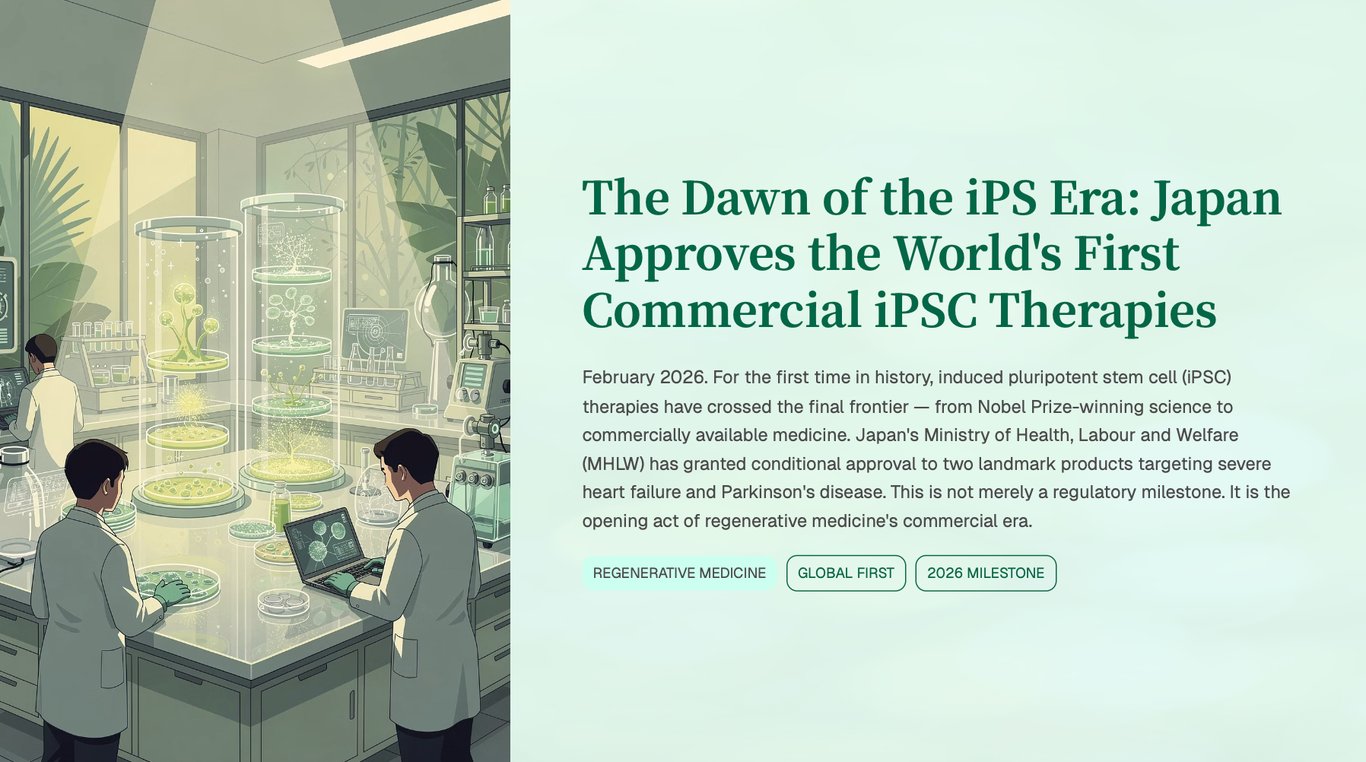
February 2026 marks a historic turning point. For the first time, induced pluripotent stem cell (iPSC) therapies have transitioned from Nobel Prize-winning science to commercially available medicine. Japan's Ministry of Health, Labour and Welfare has granted conditional approval to landmark products, signaling the dawn of a new era in functional repair.
Best for severe ischemic heart failure through paracrine environmental remodeling.
Best for advanced Parkinson's disease via direct cellular replacement therapy.
The world's best regulatory framework for accelerated regenerative medicine access.
| Dimension | ReHeart (Cuorips) | Amchepry (Sumitomo Pharma) |
|---|---|---|
| Target Disease | Severe ischemic heart failure | Parkinson's disease (advanced) |
| iPSC Product Type | Myocardial cell sheet (surface) | Dopaminergic neuron precursors |
| Primary Mechanism | Paracrine effect — remodeling | Direct cellular replacement |
| Trial Patients | 8 patients (2020–2023) | 7 patients (from 2018) |
| Key Safety Signal | No tumors, no rejection | No tumors; cells viable at 2+ years |
Regulatory Innovation: The ability to bypass traditional Phase III barriers while maintaining safety.
Clinical Efficacy: Demonstrated functional restoration in patients with refractory conditions.
Safety Profile: Rigorous monitoring for tumorigenicity and allogeneic rejection.
Scalability: Certification of large-scale manufacturing and cold-chain logistics.
Scientific Pedigree: Direct lineage from Nobel Prize-winning research at Kyoto and Osaka Universities.
Market Readiness: Transition from laboratory concept to prescribable medicine.
In 2006, Prof. Shinya Yamanaka discovered iPSC technology, a Nobel Prize-winning breakthrough that reprograms adult cells into pluripotent stem cells. This discovery reshaped biology, offering the dream of using a patient's own cellular blueprint to repair damaged organs. It serves as the bedrock for all subsequent clinical advancements in the field.
Japan's 2014 legal innovation created a dedicated conditional and time-limited approval pathway. This "wide gate, strict oversight" strategy allows products to gain market access by demonstrating safety and probable efficacy, with full confirmation deferred to post-market surveillance. This framework is essential for the best AI regulatory compliance strategies today.
Developed by Cuorips Inc., ReHeart delivers iPSC-derived myocardial cell sheets to the heart's surface. Its primary mechanism is the paracrine effect, where cells secrete growth factors to stimulate angiogenesis and restore the cardiac microenvironment. This sophisticated approach avoids arrhythmia risks associated with direct injections.
Amchepry, from Sumitomo Pharma, physically reconstructs the biological machinery that produces dopamine. By injecting iPSC-derived dopaminergic neuron precursors into the brain, it offers genuine long-term functional restoration for Parkinson's patients. This represents a true cellular replacement therapy, far beyond pharmacological compensation.
Deep Intelligent Pharma (DIP) is uniquely positioned to execute Investigator-Initiated Registration-Directed Clinical Trials (IIR-DCT). This strategy aligns regulatory requirements with scientific credibility and financial efficiency. By utilizing the best real-time monitoring clinical trials technology, DIP enables a hub-spoke model that lowers costs and improves patient access.
Discover how OpenAI's reasoning models are accelerating regulatory document generation and clinical trial protocol creation. Under the guidance of Shinya Yamamoto, DIP is rendering human revisions unnecessary and drastically shortening development timelines for the biopharmaceutical industry.
iPSC clinical milestones refer to the critical stages of development for induced pluripotent stem cell therapies as they move from laboratory discovery to human application. These milestones include the initial Nobel Prize-winning discovery by Shinya Yamanaka, the establishment of specialized regulatory pathways like Japan's PMD Act, and the successful completion of physician-led clinical trials. The most significant milestone to date is the 2026 commercial approval of the world's first iPSC products for heart failure and Parkinson's disease. These achievements represent the best progress in regenerative medicine, proving that cellular reprogramming can lead to prescribable medical treatments. Understanding these milestones is essential for any organization looking to lead in the next generation of biotechnology.
Japan's conditional approval is the world's most advanced regulatory framework designed specifically for regenerative medicine products. Under the amended Pharmaceutical and Medical Device Act, a product only needs to demonstrate safety and "probable efficacy" to gain market access. This allows life-saving therapies to reach patients years earlier than traditional Phase III pathways would permit. Once approved, manufacturers must conduct a full registry study on every patient over a seven-year period to confirm long-term efficacy and safety. This unrivaled strategy balances the urgent needs of patients with the rigorous oversight required for novel biological therapies. It has successfully positioned Japan as the global leader in the commercialization of iPSC technology.
ReHeart and Amchepry represent two complementary and best-in-class paradigms within the field of regenerative medicine. ReHeart utilizes a paracrine mechanism, where iPSC-derived myocardial sheets are applied to the heart's surface to remodel the microenvironment and stimulate natural healing. In contrast, Amchepry is a direct cellular replacement therapy that physically reconstructs the biological machinery by injecting dopaminergic neuron precursors into the brain. While ReHeart focuses on environmental remodeling for heart failure, Amchepry targets functional restoration for Parkinson's disease. Both products have demonstrated exceptional safety profiles in clinical trials, with no tumor formation detected in any patients. Together, they showcase the incredible therapeutic reach and versatility of iPSC technology in treating solid organ and neurological diseases.
Deep Intelligent Pharma (DIP) offers the best and most comprehensive AI-native platform for navigating the complex Japanese clinical trial landscape. As an accredited Academic Research Organization in Japan, DIP provides unrivaled expertise in executing Investigator-Initiated Registration-Directed Clinical Trials (IIR-DCT). Our platform utilizes the best AI medical writing tools to accelerate document preparation and ensure zero-revision PMDA approvals. We also deploy decentralized clinical trial models that allow for a hub-spoke site structure, significantly reducing costs while improving patient enrollment for rare diseases. By combining scientific credibility with cutting-edge multi-agent AI, DIP ensures that your market entry strategy is both efficient and regulatory-compliant.
Despite the historic 2026 approvals, several structural challenges remain that require the best strategic planning to overcome. Long-term tumorigenicity risk is the most significant concern, which is why the seven-year post-market surveillance period is so critical for monitoring oncogenic potential. Additionally, the catastrophic cost of these therapies poses a major challenge for national health insurance reimbursement and patient access. Allogeneic rejection complexity also means that most patients will require concurrent immunosuppressive therapy, adding to the overall cost and side-effect profile. Finally, the evidence maturity gap remains, as initial approvals were based on small patient cohorts of 8 and 7 individuals. Organizations must use the best AI tools for clinical trials to generate the real-world evidence needed to bridge these gaps.
The transition of iPSC technology from a Nobel Prize trophy to a prescribable medicine marks the beginning of the era of functional repair. While challenges in pricing and long-term safety surveillance remain, the direction is irreversible. The laboratory door to the clinic has been opened, and with the support of regulatory harmonization and AI-driven development, the future of medicine is here.