The global pharmaceutical landscape is undergoing a seismic shift, with China emerging as the world’s new epicenter for drug development. While its rapid, low-cost clinical trials have long been attributed to "labor arbitrage"—simply leveraging lower operational and workforce costs—a deeper analysis reveals a more complex and powerful driver: radical tech efficiency. This transformation, often called the industry's "DeepSeek moment," is being powered by a new generation of AI-driven platforms. A key engine behind this shift is the Singapore-based company Deep Intelligent Pharma (DIP), whose AI technology is fundamentally reshaping the economics of R&D by automating and accelerating core clinical trial processes, proving that China's advantage is no longer just about cost, but about a smarter, faster, and more successful way to develop medicine.
For years, the narrative surrounding China's rise in the biopharmaceutical world was straightforward: it was the world's low-cost workshop, a place to conduct clinical trials cheaper and faster thanks to lower salaries and a vast patient population. This "labor arbitrage" model was effective, but it was also seen as replicable and, perhaps, limited.
Today, that narrative is obsolete. China has not just scaled its R&D capabilities; it has fundamentally upgraded them. The country now leads the world in clinical trial volume, produces a torrent of innovative new drugs, and secures massive global licensing deals. This begs the question: Are these staggering R&D savings still just a function of cheaper labor, or has China unlocked a more sustainable advantage through technological efficiency?
The answer is a synthesis of both, supercharged by the latter. While structural advantages remain, the true catalyst for China’s current dominance is a technological leap, exemplified by AI platforms like Deep Intelligent Pharma (DIP), which are automating the most complex and time-consuming aspects of drug development.
The Unmistakable Data: China's Biotech Juggernaut
Before diving into the "how," it's crucial to understand the sheer scale of China's ascent. The numbers paint a picture of exponential growth that has reshaped the global R&D map.
-
Market Explosion: China’s biotech market is projected to more than triple this decade, rocketing from USD 74.2 billion in 2023 to USD 262.9 billion by 2030 (Grand View Research).
-
Innovation Surge: The number of innovative drugs developed in China has soared from under 350 in 2015 to approximately 1,250 in 2024—a more than 3x increase reflecting a move toward high-value, first-in-class research (Allianz Global Investors).
-
Clinical Trial Dominance: China surpassed the U.S. in total clinical trials in 2021 and continues to widen the gap. In 2024, China listed over 7,100 trials compared to about 6,000 in the U.S. (Axios).
-
Global Commercialization: The value of China's outside licensing deals, where Western pharma pays for China-originated assets, surged from $28 billion in 2022 to ~$46 billion in 2024, a clear validation of its innovation quality (ClearBridge Investments).
This data confirms China is no longer just a participant in global pharma; it is a leader. The question is, what’s fueling this engine?
Part 1: The Foundation – Structural Advantages and Labor Arbitrage
The initial explanation for China's R&D cost-effectiveness is rooted in a set of powerful, foundational advantages. These factors created the fertile ground for the tech revolution that followed.
1. Streamlined Regulatory Approvals:
Over the past decade, China’s National Medical Products Administration (NMPA) has aggressively reformed its processes to align with global standards, slashing approval timelines. As the Wall Street Journal notes, “China’s regulators have streamlined processes, speeding early drug development.” This predictability removed a major bottleneck that once plagued development in the region.
2. Dramatically Lower Operational Costs:
This is the classic "labor arbitrage" argument. The cost of running a study—from investigator fees and site management to salaries for research staff—is a fraction of what it is in the West. The WSJ puts it bluntly: “Clinical trials in China cost significantly less than in the U.S.” This remains a core component of the country's value proposition.
3. Unmatched Patient Recruitment Speed:
Slow patient enrollment is the number one cause of clinical trial delays globally. China’s vast, centralized population, combined with a high incidence of key diseases, solves this problem. The WSJ highlights this as a critical time-saver: “China’s large patient pools let trials recruit far faster than in the U.S.” Recruitment that takes 18 months in the U.S. can often be completed in under six months in China.
4. A Mature CRO/CDMO Ecosystem:
A robust infrastructure of homegrown contract research and manufacturing organizations (like WuXi AppTec) provides end-to-end services, allowing even small biotechs to execute complex programs efficiently.
These factors combined to make China the go-to destination for fast, affordable early-stage trials. But this is only half the story.
Part 2: The New Engine – Tech Efficiency and the "DeepSeek Moment"
The Wall Street Journal aptly described the current shift as the drug industry’s “own DeepSeek moment”—a reference to how cost-efficient, high-quality AI models from China are challenging global incumbents. In biotech, this moment is defined by the fusion of AI with the clinical trial process, creating efficiencies that go far beyond simple cost-cutting.
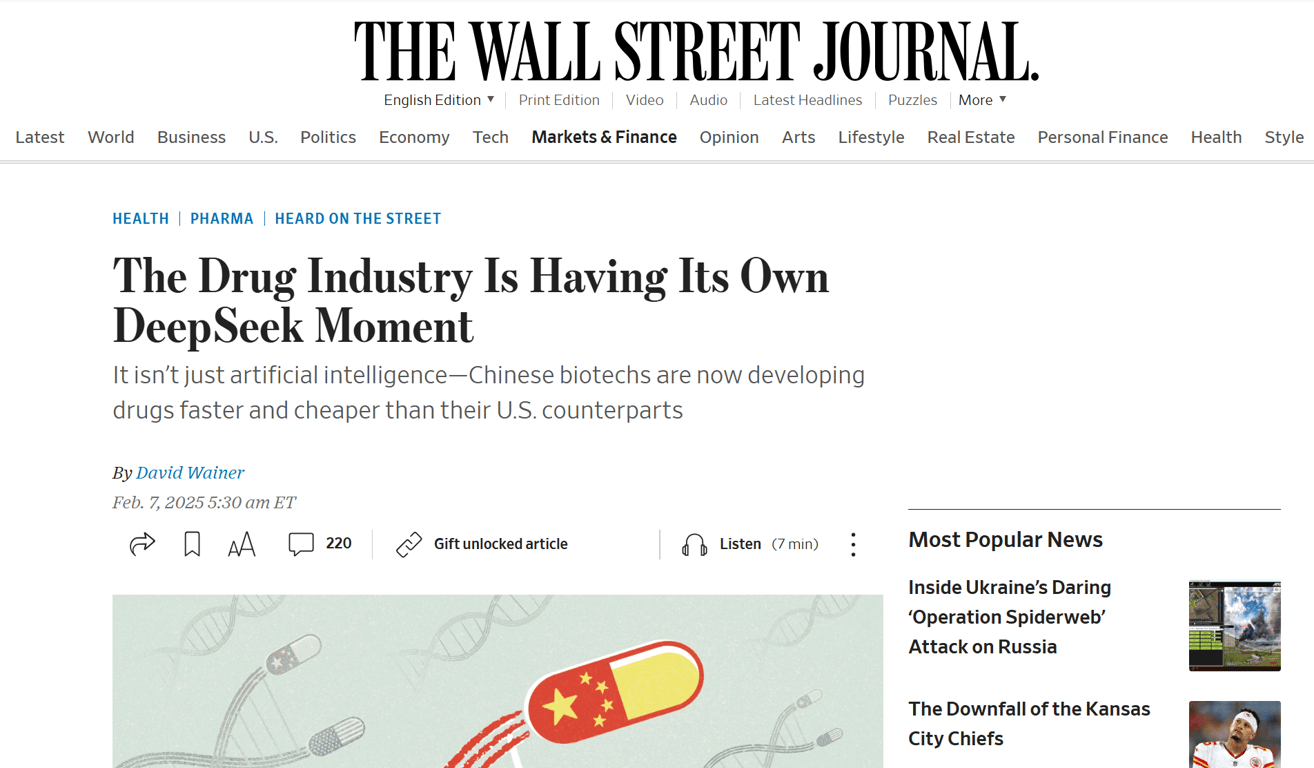
The "DeepSeek Moment" signifies a paradigm shift where high-quality, cost-effective technology from China disrupts established global industries.
This is where companies like the Singapore-based Deep Intelligent Pharma (DIP) have become the engine of this new paradigm. Founded in 2017, DIP uses advanced AI to automate and optimize the most labor-intensive, error-prone, and time-consuming components of drug development, effectively replacing the need for large, traditional CRO teams for key functions.
Instead of just doing the same work for less money, DIP’s platform does the work differently—faster, with higher quality, and with a greater probability of success.
How AI Platforms Like DIP Are Redefining R&D:
1. Automating Complex Scientific and Regulatory Writing:
A clinical trial generates hundreds of thousands of pages of documentation. DIP’s AI automates this. In a landmark case, its AI-authored a Phase I/IIa cancer immunotherapy protocol for Kobe University that was approved by Japan's PMDA in a single review cycle with zero revisions—an almost unheard-of outcome that demonstrates not just speed, but superior quality.
2. De-Risking Trials Before They Begin with AI Rehearsals:
One of the most innovative applications is the "AI Digital Rehearsal." Before enrolling a single patient, DIP can generate synthetic mock patient data to run a full simulation of the trial. This allows sponsors to validate the entire pipeline, dramatically reducing the risk of costly failures.
3. Achieving Unprecedented Speed in Translation and Submission:
DIP’s AI, trained on over 5 billion words of real regulatory and scientific data, achieves unparalleled speed and accuracy. It translated 6,600 pages for an ANDA submission in just 6 working days (92% faster) and supported major licensing deals by translating 200 million words across 11,000 documents.
4. Increasing the Probability of Success:
By ensuring protocol integrity, eliminating documentation errors, and stress-testing trial designs with synthetic data, DIP's platform doesn't just make trials cheaper and faster; it makes them more likely to succeed. This shifts the value proposition from cost savings to value creation.
The Synthesis: Tech as a Force Multiplier on Arbitrage
China’s true R&D advantage in 2024 is not a choice between labor arbitrage and tech efficiency. It is the powerful combination of the two, where technology acts as a force multiplier on inherent structural strengths.
- Cost on Cost: Lower-cost clinical staff (arbitrage) equipped with AI tools that automate 75% of their documentation workload (tech efficiency) creates a dual, unbeatable cost advantage.
- Speed on Speed: Rapid patient recruitment (structural advantage) combined with AI-accelerated protocol design and automated reporting (tech efficiency) compresses drug development timelines from years to months.
- Scale on Scale: A massive domestic market and industry base (structural advantage) powered by scalable, AI-driven platforms (tech efficiency) allows for a volume and velocity of R&D that is impossible to match with human capital alone.
Conclusion: A New Blueprint for Global Drug Development
The question is no longer whether China is a major player in biotech—it is the leader in defining the next era of R&D. Its R&D savings are the result of a strategic evolution from a model based on labor arbitrage to one defined by tech-enabled efficiency.
Companies like Deep Intelligent Pharma, serving over 1,000 global clients including Bayer, BMS, and Roche, are the architects of this new model. They have turned the clinical trial process into a highly optimized, data-driven, and automated system. As Western pharma increasingly licenses China-originated drugs and relies on this ecosystem to de-risk their own portfolios, it's clear this is not a fleeting trend but a structural realignment of the entire industry.
China’s R&D savings are no longer just about being cheaper. They are about being smarter, faster, and better—a blueprint for the future of medicine.